
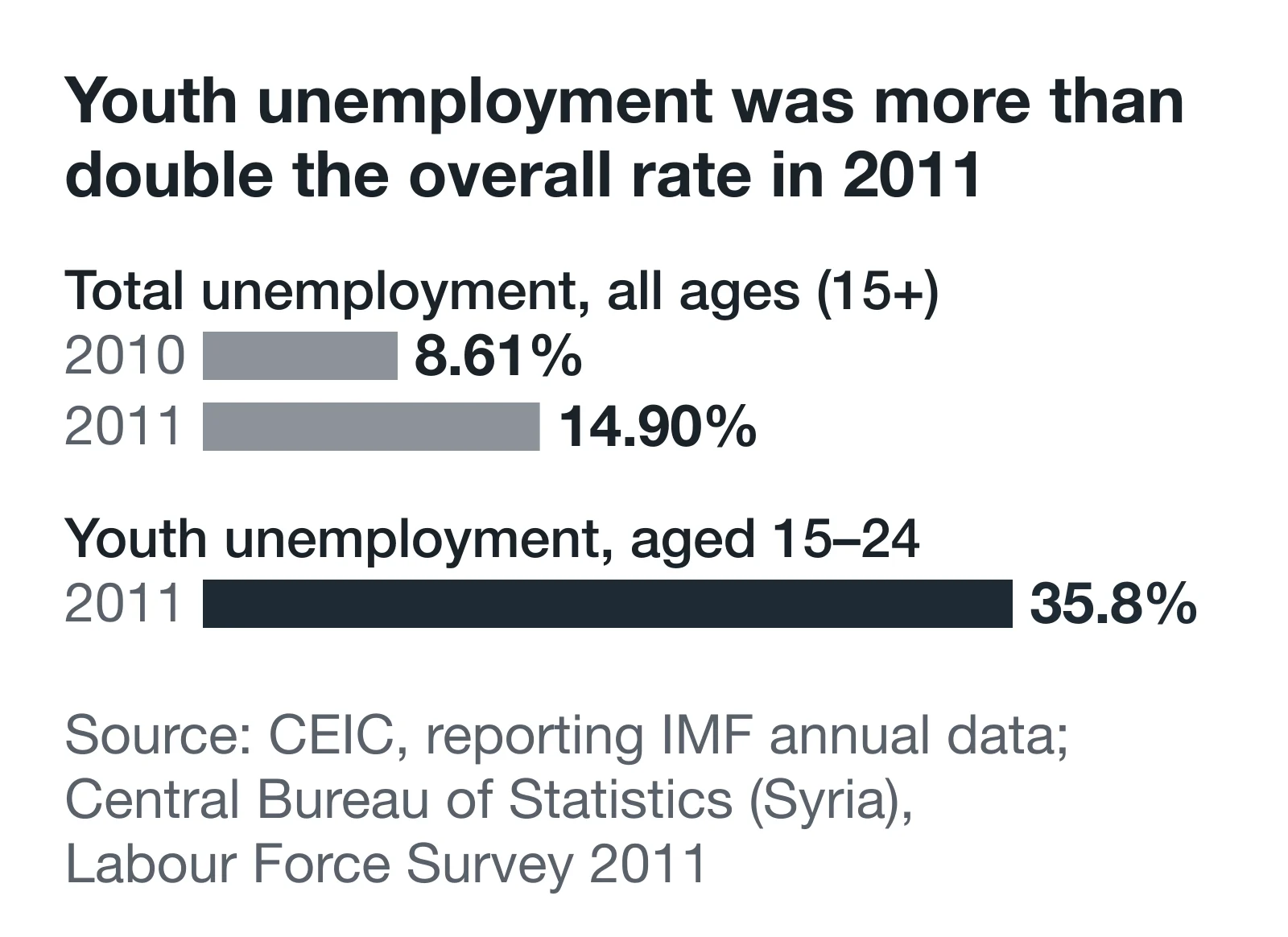
In 2011, Syria’s overall unemployment rate was 14.9%, while the rate for people aged 15–24 reached 35.8%, according to official figures compiled by the Central Bureau of Statistics and carried by CEIC. The gap is visible in the youth rate and the all-ages rate; detailed age groups beyond the youth cut are not consistently available in live public sources.
What the indicator measures
The unemployment rate expresses unemployed people as a percentage of the labour force. The rate is calculated as the number of unemployed people divided by the labour force, multiplied by 100. The labour force excludes people outside working age and those not looking for work. The labour force covers people available for work who are employed or actively seeking it. Youth unemployment applies the same calculation to people aged 15–24. Syria’s accessible 2011 series reports that age cut rather than a full age pyramid. The distinction matters because young entrants often respond differently to economic pressure than older workers; comparing the two rates helps separate structural difficulty from cyclical slowdown. For background on how the Syrian labour force is defined, see labour force in Syria.
Who produces it and how
The Central Bureau of Statistics (Syria) is the official producer of Syria’s labour force data. Its Labour Force Survey 2011, summarised in the Statistical Abstract 2012, is the source usually cited for the 2011 age cut. The bureau runs the survey as a sample enquiry of households; because the Syrian publication is not always available online, international databases re-export parts of it. CEIC carries the annual unemployment series with the International Monetary Fund listed as the original compiler; CEIC categorises the series under the IMF’s International Financial Statistics table for the Syrian Arab Republic. The World Bank’s World Development Indicators also carry the total unemployment rate for Syria. For background on the institution, see Central Bureau of Statistics Syria; for the preceding year’s statistical framework, the 2010 statistical yearbook page records the 2010 reference tables.
The 2011 figures at a glance
Two rates are available for 2011 with enough public confirmation to publish side by side. The table sets the total and youth cut against the 2010 total. For the broader employment context, see Syria employment statistics 2011.
| Age group | 2010 | 2011 | Source |
|---|---|---|---|
| Total unemployment, all ages (15+) | 8.61% | 14.90% | CEIC, reporting IMF annual data |
| Youth unemployment, aged 15–24 | not confirmed in live public sources | 35.8% | Central Bureau of Statistics (Syria), Labour Force Survey 2011 |
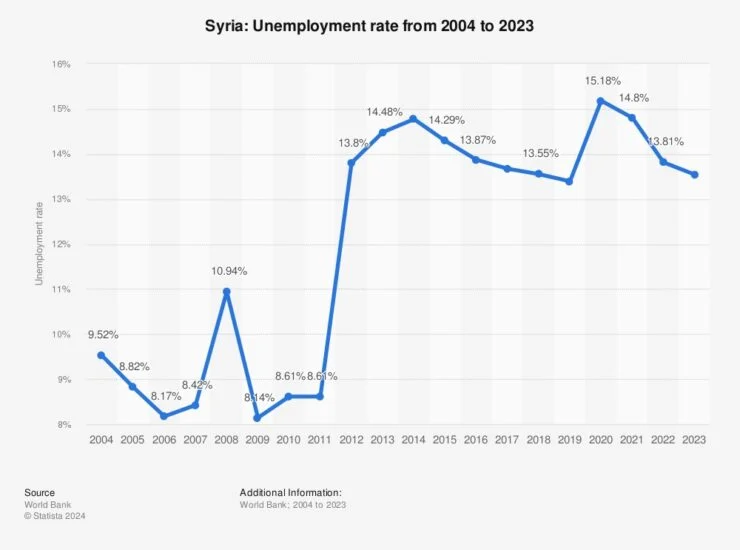
CEIC’s series, with the International Monetary Fund as original compiler, reports 14.896% for 2011 and 8.613% for 2010; the table rounds to one decimal place. The 2010 youth rate is not confirmed in live public sources. CEIC also records 866,280 unemployed people and a labour force of 5,815,520 in 2011; those levels sit behind the 14.9% headline rate. The table therefore offers a reliable two-row comparison; it is not a complete age distribution.
2010 vs 2011
The total rate rose from 8.61% in 2010 to 14.90% in 2011, an increase of 6.3 percentage points in one year. The same CEIC series records an 81.9% increase in the number of unemployed people between 2010 and 2011. For the age cut, the 2011 youth rate of 35.8% is more than double the all-ages rate and sits 20.9 percentage points above it; the gap suggests that young Syrians carried a disproportionate share of unemployment in 2011. A comparable 2010 youth figure is not available from a live source, which limits the age-disaggregated comparison to the youth-versus-total relationship for 2011. For the 2010 labour force context, see 2010 labour force data.
Limits and gaps
The main limits are:
- Official figures cover the areas and years administered by the Syrian government at the time. Areas outside government control were not consistently surveyed in 2011.
- The published age cut is usually limited to 15–24, so rates for 25–54 and 55+ are not available from the live sources used here.
- After 2011, United Nations estimates fill some gaps, but they are not directly comparable to the Labour Force Survey 2011.
The figures should be read as the official Syrian labour force series for 2011, not as a full national estimate for the crisis year.
Where to download the data
The 2011 total can be checked in the World Bank’s World Development Indicators page for total unemployment in Syria, which carries the 2010 and 2011 figures. CEIC’s annual series for Syria is available on its labour force page. The Central Bureau of Statistics (Syria) publication should be cited by organism, year and table when the Syrian edition is available. For academic use, a citation to the Labour Force Survey 2011 or the Statistical Abstract 2012 is the cleanest way to source the youth figure. When the Syrian source is unavailable, the World Bank and CEIC versions are acceptable secondary references.

Published by